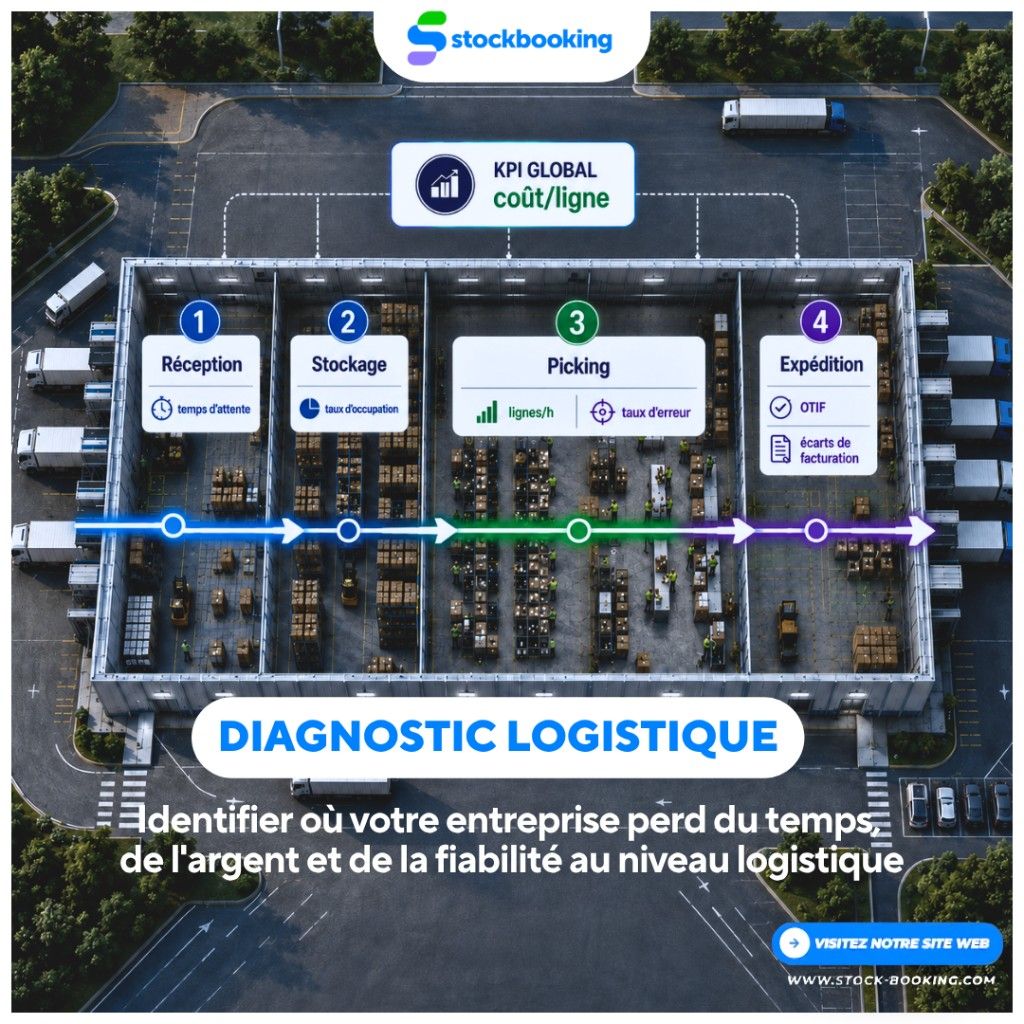
A warehouse that “works more or less fine” often costs more than one whose breaking points are precisely known. In 2026, with transport cost pressure, labour shortages in order picking and rising shipper expectations on lead times, a logistics diagnostic is no longer reserved for large groups: it has become the mandatory starting point for any logistics SME or 3PL that wants to allocate investments without guessing.
This article details a complete logistics diagnostic method: KPIs analysed, real intervention duration, expected deliverables, a concrete use case and before/after results.
What is a logistics diagnostic?
A logistics diagnostic is a structured assessment of warehouse or logistics-site performance, based on real operational data (WMS, ERP, shop floor) cross-checked with industry benchmarks. The goal is not a simple status report, but to identify the highest-ROI improvement levers in the short term—those that require neither a full IT overhaul nor heavy infrastructure investment.
Unlike a simple site visit, a logistics diagnostic relies on quantified data and a reproducible methodological framework, enabling comparisons over time and across warehouses in the same network.
Logistics diagnostic vs logistics audit: what is the difference?
The two terms are often used interchangeably, but they cover different logics:
- A logistics audit generally targets compliance: procedures, quality standards, regulation (safety, special product storage, etc.). It answers: “Are we doing what we are supposed to do?”
- A logistics diagnostic targets performance: it answers: “Where are we losing time, money and reliability—and in what order should we fix it?”
In practice, a well-run logistics diagnostic often includes a compliance angle, but its core deliverable remains an action plan prioritised by expected gain—not a compliance checklist. To go deeper on profitability signals, also see our article on the logistics audit.
The logistics diagnostic method, step by step
KPIs analysed
A serious logistics diagnostic is not limited to one or two KPIs. It crosses service, cost and physical-flow indicators:
- Service level (OTIF): share of orders delivered on time and in full
- Picking error rate: picking errors vs lines processed
- Cost per order line: key indicator to compare a site’s real profitability
- Picking productivity: lines or parcels processed per hour per operator
- Stock occupancy and rotation: to spot overstock, dormant inventory or underused zones
- Order-to-ship time: delay between order receipt and shipment
- Damage and return rate: a signal of packaging or handling issues
- Inventory accuracy: gap between theoretical stock (WMS/ERP) and physical stock
These KPIs are measured over a representative period (typically 3 to 6 months of history), then complemented by shop-floor observation of flows that never appear in systems.
Duration and flow of a logistics diagnostic
A full logistics diagnostic usually follows a tight format designed not to paralyse operations:
- Remote framing (D-5 to D-1): WMS/ERP data extraction, scope definition (warehouse, product line, seasonality to account for)
- On-site immersion (1.5 days): observation of real flows, interviews with picking and supervisory teams, timing of critical tasks, confrontation of system data with actual practices
- Analysis and modelling (1 day): KPI cross-check, industry benchmark, identification of significant gaps
- Feedback session (half a day): presentation of the action plan to leadership
This 3-day format is intentionally short: experience shows that going longer collects more data without gaining relevance, while the cost of immobilising internal teams rises.
Logistics diagnostic deliverables
At the end of the diagnostic, the company should have three concrete outputs—not a purely descriptive report:
- A performance dashboard with measured KPIs and their position vs industry benchmark
- A loss map: quantification, in euros or hours, of each identified dysfunction
- A prioritised action plan ranking levers by gain/effort ratio, with ROI sizing for each action
That last point separates a useful logistics diagnostic from a report that ends up in a drawer: every recommendation must be actionable within 90 days, without depending on an IT rebuild project.
Use case: logistics diagnostic for a growing 3PL
A logistics provider (3PL) operating a 3,000 m² warehouse for about ten shippers faced a common situation: order volume up 30% in one year, with no clear visibility on the cause of increasingly frequent delays flagged by shipper clients.
The logistics diagnostic highlighted three main causes invisible in classic monthly reports:
- Obsolete slotting based on volumes from two years earlier, generating excessive picking travel
- A spike in picking errors concentrated on three high-rotation SKUs poorly positioned in the warehouse
- Unmeasured admin time on rush orders, absorbing about 20% of a dedicated team’s time
None of these three points required WMS or infrastructure investment: targeted re-slotting, a reorganisation of picking zones and a dedicated rush-order procedure were enough to address most of the issue.
Before / after: quantified results of a logistics diagnostic
On this case, KPIs measured before the intervention and 90 days after implementing the action plan show the scale of gains possible without heavy investment:
| KPI | Before diagnostic | After 90 days | Change |
|---|---|---|---|
| Service level (OTIF) | 91% | 98% | +7 pts |
| Picking error rate | 3.2% | 0.4% | −87% |
| Cost per order line | baseline 100 | 82 | −18% |
| Productivity (lines/hour) | baseline 100 | 125 | +25% |
| Order-to-ship time | 36 h | 14 h | −61% |
These figures illustrate a constant reality for this type of intervention: most logistics performance gains come from fixing organisational issues, not from technology investments. The diagnostic’s job is precisely to separate one from the other before committing budget.
When should you call an external logistics diagnostic?
An internal logistics diagnostic often hits a structural bias: teams running the site struggle to challenge their own practices, and leadership lacks time to objectify weak signals (occasional delays, customer claims, picking turnover).
An external diagnostic, run as a short format such as the Stockbooking logistics diagnostic, brings three concrete advantages:
- A benchmarked reading grid from observing comparable warehouses, avoiding closed-loop self-assessment
- A view without hierarchical stakes, allowing shop-floor teams to flag issues they would not escalate internally
- A short, framed format (3 days), designed not to freeze operations or produce a report that will never be read
The most common triggers for a logistics diagnostic request are volume growth outpacing the organisation, recurring customer claims on lead times, an investment project (WMS, space extension, robotics) to derisk before costing, or simply the lack of quantified visibility on real site performance. For ongoing follow-up once the action plan is launched, a module such as the 3PL client portal extends that visibility day to day, beyond the initial intervention.
Conclusion
A well-run logistics diagnostic is not measured by report thickness, but by how quickly its recommendations can be implemented. By crossing quantified data and shop-floor observation in a short format, it helps a warehouse or 3PL identify real improvement margins before any technology investment.
If you want to objectify your warehouse performance without waiting for the next peak to discover your breaking points, the Stockbooking logistics diagnostic offers this diagnostic in a 3-day format, with an action plan delivered within a week.
Talk to a Stockbooking expert to frame your scope.
Logistics diagnostic FAQ
How much does a logistics diagnostic cost?
Cost varies with site size and scope. A short format like the Stockbooking logistics diagnostic, with 3 days of immersion, typically sits in the low thousands of euros—usually offset by gains identified within the first 90 days.
What is the difference between a logistics diagnostic and a quality audit?
A quality audit checks compliance with standards or procedures. A logistics diagnostic assesses operational performance (costs, lead times, reliability) and delivers a quantified action plan.
Does a logistics diagnostic require shutting down the warehouse?
No. The method relies on on-site immersion alongside normal operations, complemented by remote WMS/ERP data analysis.
Is a logistics diagnostic suitable for SMEs and smaller 3PLs?
Yes—it is especially suited to SMEs and 3PLs: unlike a multi-week heavy audit, a short diagnostic delivers an actionable plan without dedicating an internal team for weeks.