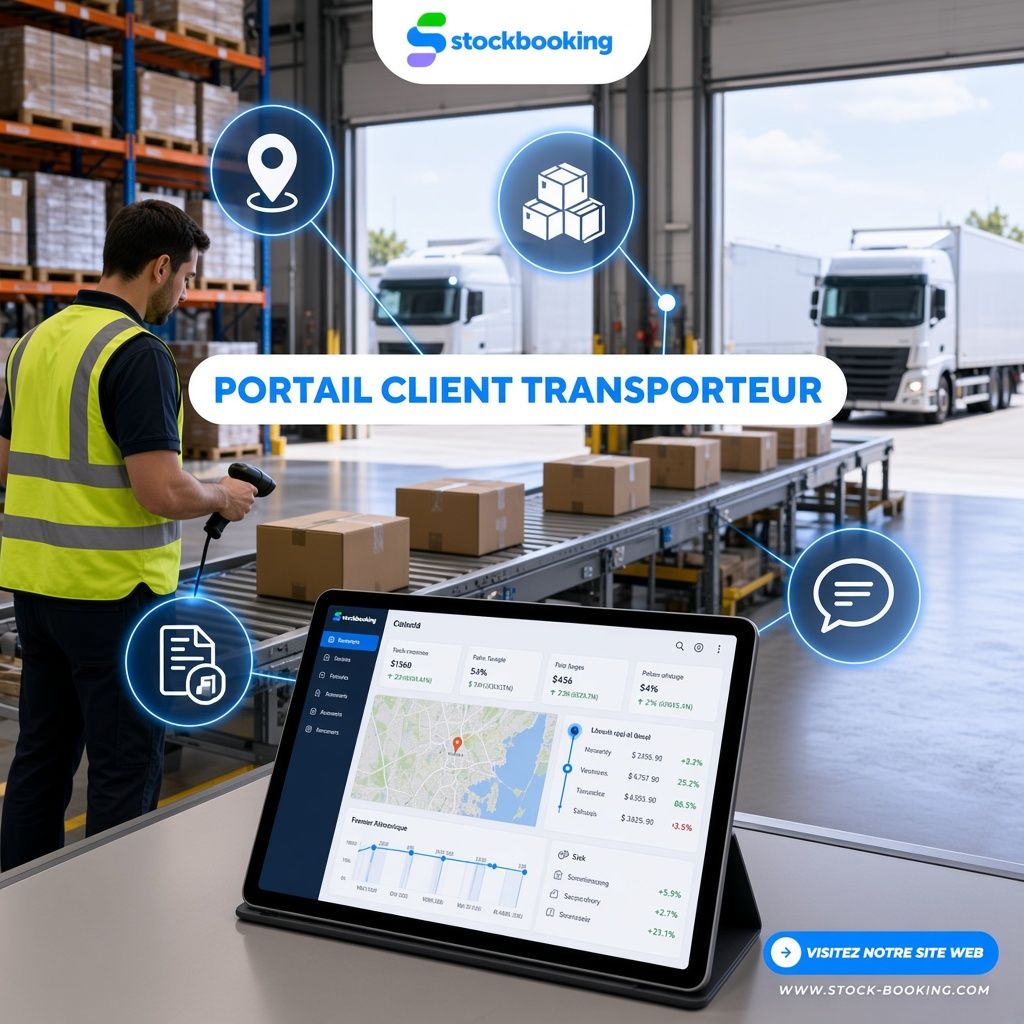
Your customers are used to tracking an Amazon parcel in three clicks, without ever needing to call anyone. They naturally expect the same transparency from their carrier or logistics provider—and a client portal is no longer a premium differentiator, but an implicit standard against which you are measured, even if it has never been stated explicitly.
What your customers expect from a portal today
The question is no longer whether a client wants direct access to information on shipments or stock, but why they should still have to call or email to get it. The absence of a client portal translates very concretely into repeated requests to your sales or operations teams, often for information the client could look up themselves at any time. This grows with client size: the more volume they do with you, the more frequent these requests become, until they represent a significant workload for a single key account.
Real-time visibility: a direct impact on trust
A client who can track shipment or stock status without an intermediary naturally develops more trust in their provider. This visibility reduces anxiety around uncertainty—“where is my order? has it shipped? is there a delay?”—and turns a potentially tense relationship into a transparent, calmer one. This is especially true for clients working with a multi-site logistics provider, where visibility on stock spread across several warehouses becomes a management issue for them as well, not only for the provider. See also our article on the 3PL WMS.
Conversely, the absence of visibility creates a classic pattern: the client calls “just to check”, even when everything is fine, simply because they have no other way to be sure. This informational anxiety almost entirely disappears once a reliable portal is available.
Fewer requests, more time for your teams
Every call or email avoided thanks to a self-service portal is time given back to your operations and sales teams. Over a month, across several dozen active clients, this often adds up to several recovered hours, which can be reinvested in genuinely complex cases—claims, special requests, business development—rather than repeatedly answering basic, predictable status questions.
The features expected of a good client portal
Real-time shipment tracking
This is the most expected and most consulted feature: order status, ship date, carrier used, tracking number where applicable. It is also the one whose absence generates the highest volume of direct requests.
Stock-level visibility
For clients using a warehousing service, the ability to see their own stock in real time—available quantities, recent movements, low-threshold alerts—lets them anticipate replenishment without depending on a manual exchange with the provider.
Order history
A searchable, filterable history stops the client from contacting customer service to retrieve information that has already been processed—a frequent and yet easily avoidable request.
Access to related documents
Delivery notes, invoices, transport documents: centralising these in the portal rather than emailing them one by one reduces both requests and the risk of documents being lost on the client side.
The point of these features is not technical sophistication but clarity of use: a portal the client understands and uses alone in thirty seconds is structurally worth more than a complete but confusing tool that will end up generating calls… to learn how to use the portal itself.
Impact on the customer relationship and retention
Beyond the immediate operational gain, a well-designed client portal becomes a concrete commercial differentiator, usable as early as the tender phase. Faced with two providers equivalent on price and operational service, the one that offers autonomous, reliable visibility inspires more trust over time—and mechanically reduces the risk of losing a client over a simple communication gap, a frequent cause of commercial break-up even when the underlying logistics service is sound. A logistics audit makes this hidden cost of requests and communication friction visible.
In short
A carrier client portal is no longer a premium option: it has become an implicit expectation of your customers. Providers who still ignore it expose themselves to avoidable requests, unnecessary internal workload, and a competitive disadvantage against players who have already taken this step.
Frequently asked questions
Is a client portal useful for a small logistics provider?
Yes: even with a small client portfolio, fewer repeated requests and the perceived gain in trust play a disproportionate role relative to the effort of putting it in place.
Should you build a custom portal or use an existing solution?
An existing solution, natively integrated with the 3PL WMS, generally avoids the cost and lead time of a custom portal, for an equivalent functional result from the client’s point of view.
Does the client portal replace human contact entirely?
No: it absorbs basic, recurring status requests, which actually frees time for higher-quality human contact on the issues that really need it.