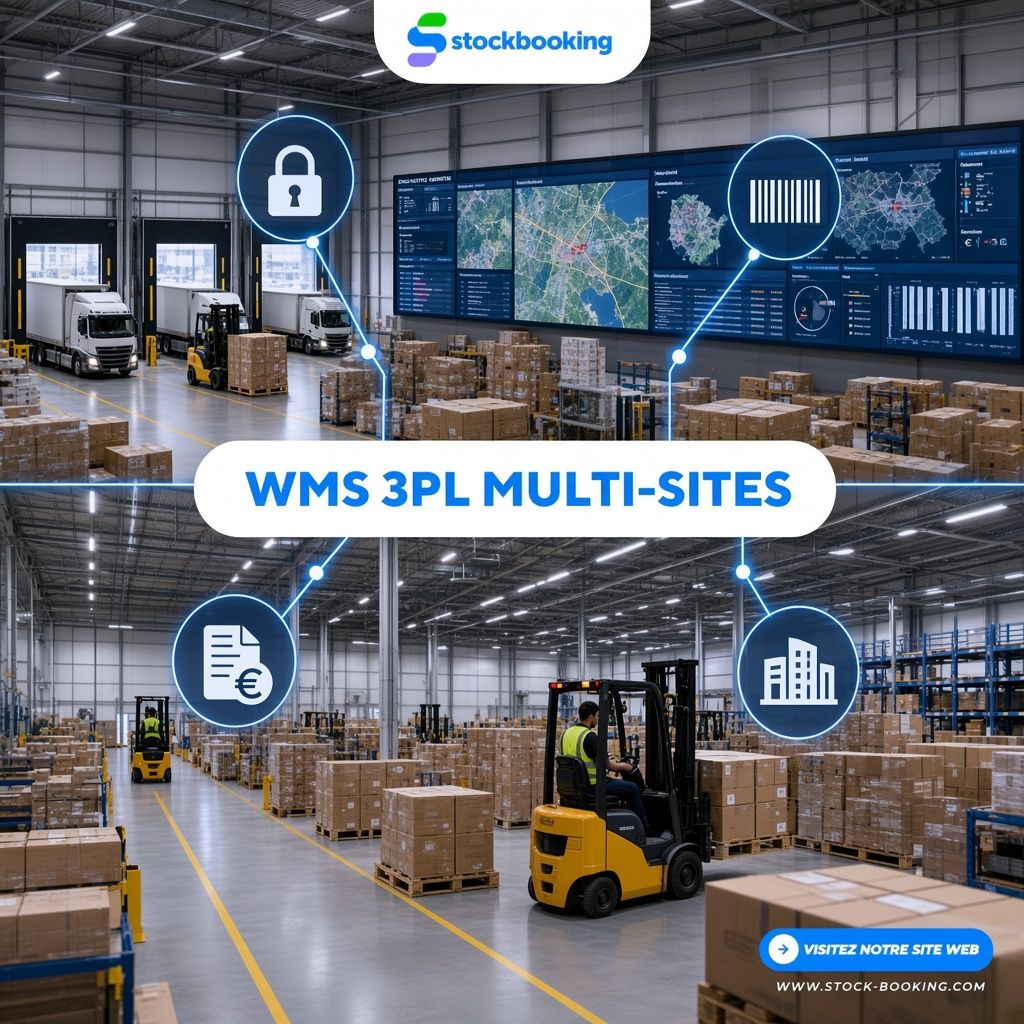
Running a warehouse for your own account and running several warehouses on behalf of several clients are two different businesses. A logistics provider (3PL) needs a WMS designed natively for that complexity, not a single-client tool later twisted into shape with heavy custom development.
What makes a multi-client, multi-site WMS different
Isolating data by client
A 3PL WMS must isolate each client’s inventory, flows and data, while still providing a consolidated view for the provider to run the business. That implies fine-grained access rights: each client must see only their own data, with no risk of leakage to a competing client hosted on the same site. It is also the foundation of a reliable carrier client portal.
Differentiated picking rules
Each shipper often has its own requirements: specific labelling, particular packaging, picking priorities tied to their activity. A 3PL WMS must let you configure these rules client by client, without complicating the daily work of operators handling SKUs for several clients at once.
Multi-site consolidation
For providers operating several warehouses, the ability to consolidate a global view of activity—load by site, stock availability, residual capacity—becomes a strategic management issue, not only an operational one. A WMS designed for a single operator structurally cannot meet this need for a cross-site view.
Traceability: the number-one issue for a 3PL
For a logistics provider, traceability is not a comfort: it is a contractual obligation to each client. Every stock movement must be tied precisely to a client, a lot and an order, with a history that can be consulted in the event of a dispute or audit. This traceability requirement is also what makes it possible to give each client reliable visibility on their own inventory, without depending on time-consuming manual reporting by the provider’s teams—reporting that, at the scale of several simultaneous clients, quickly becomes impossible to maintain reliably.
Per-client billing: a point often underestimated at the time of choice
Many 3PLs discover their tool’s limits on this point too late: billing each client accurately for services actually performed—storage, order picking, special handling, returns—assumes that the WMS captures these data as they happen, operation by operation, not as an approximate reconstruction at month-end. A well-designed 3PL WMS builds this direct link between operational activity and billing, which structurally limits lost revenue from services performed but not rebilled—a phenomenon that weighs directly on warehouse profitability without always being identified as such. A logistics audit makes it visible.
The case of a multi-site logistics provider
Take a 3PL operating two warehouses for five different clients. Without a suitable WMS, each site runs in a silo, with tools or methods that differ according to each site’s history, making any real-time load arbitration between sites impossible. When one client peaks on a site that is already saturated, the provider often discovers the problem too late, once picking delays have already been noticed by the client.
With a centralised 3PL WMS, the provider can instead see each site’s load in real time, reroute flows during peaks, and present each shipper with standardised, reliable reporting—a strong commercial argument in tenders, where many competitors still offer manual or approximate reporting.
In short
A 3PL WMS is not chosen like a standard WMS: the ability to isolate data by client, trace every movement precisely and automate the associated billing are the criteria that determine whether the tool is viable—and, ultimately, the real profitability of a multi-client logistics operation.
Frequently asked questions
Can a standard WMS work for a 3PL?
Technically it can work for a single client, but it quickly shows its limits as soon as several shippers share the same warehouse: data isolation, differentiated rules and detailed billing become hard to manage without costly custom development. An SME WMS addresses a different need: digitising a single-client site without excessive complexity.
How does a 3PL WMS improve billing?
By capturing every operation performed for a client at the moment it happens, the WMS enables exhaustive, automated billing, rather than a month-end reconstruction that often leaves services unbilled.
Is a 3PL WMS useful for a single-site provider?
Yes, as soon as several clients share the same warehouse: isolating data and picking rules remains necessary even without multiple sites.