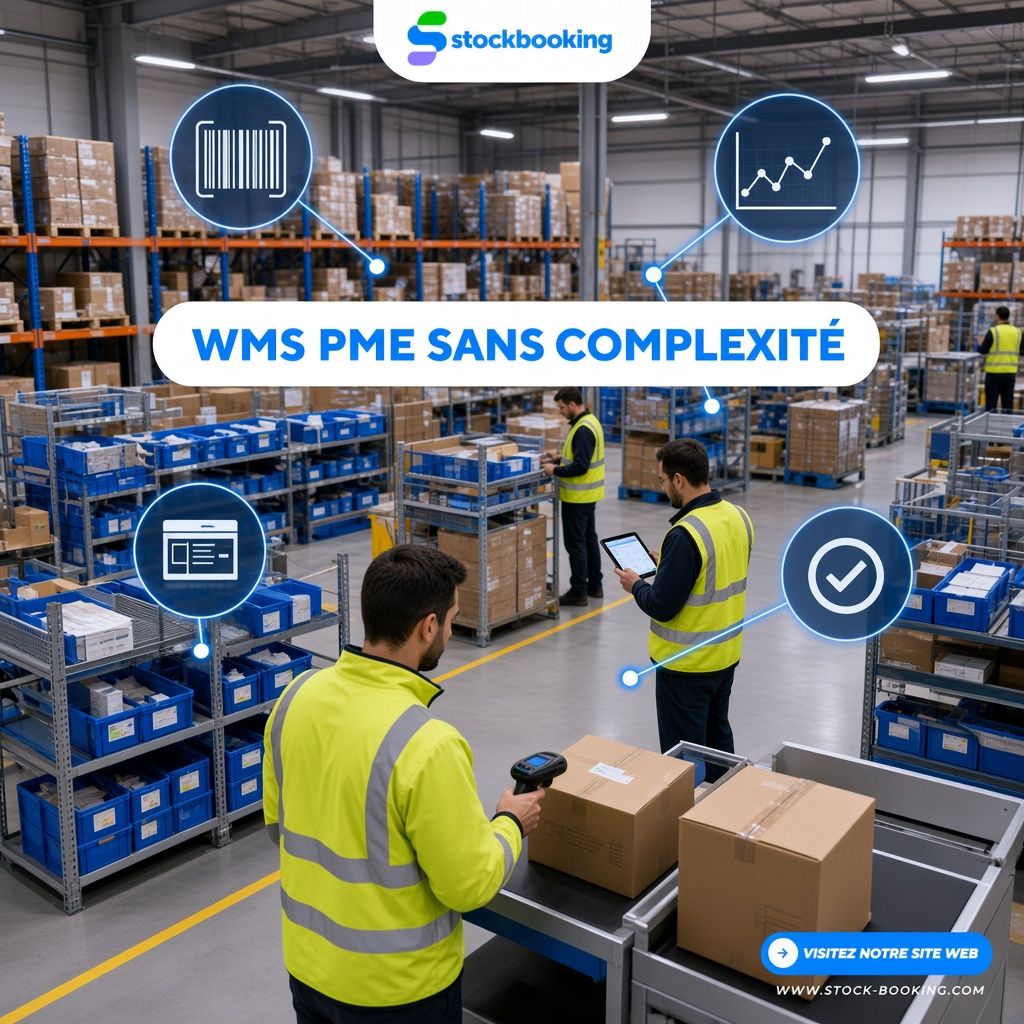
WMS (Warehouse Management System) software long had a reputation as a tool reserved for large warehouses, with multi-month projects run by a dedicated IT team. That image still sticks with many SME leaders, even though current solutions have been widely democratised. The question is no longer “do I have the critical size for a WMS?”, but “is my current management costing me time and reliability every day?”.
A WMS is no longer reserved for large groups
Vendors now offer modular solutions, configurable without advanced technical skills, designed for teams of just a few operators. Unlike historical WMS built for warehouses of tens of thousands of square metres, today’s SME WMS deploy with a deliberately tight functional scope at the start: location management, picking guidance, real-time stock tracking—then more features as the company’s real needs grow.
This changes the economic equation: an SME managing a few hundred SKUs and a few dozen orders a day can now access features once reserved for large accounts, without the cost or complexity that historically came with them. The right SME logistics software is therefore no longer necessarily the most complete one, but the one that matches this volume.
Common barriers… and why they are often overstated
Cost
This is the most cited barrier, but it is rarely set against the hidden cost of current management: stockouts not detected in time, double entry between systems, time spent looking for a misplaced SKU. A well-sized SME WMS is generally paid back by reducing these silent losses, more than by an immediately visible line on the invoice. The right reflex is to quantify, even approximately, the current cost of these inefficiencies before comparing it with the price of the tool.
Deployment time
The image of a multi-month project remains vivid, inherited from large historical WMS programmes. A solution designed for SMEs can instead be operational in a few weeks, provided you deliberately limit the functional scope at the start: digitise receiving and picking first, then add more advanced modules once teams are comfortable with the tool.
Team training
This is the most legitimate barrier, but also the easiest to anticipate. An interface designed for shop-floor operators—barcode scan, simple visual guidance, explicit error messages—dramatically reduces the learning curve compared with a generic ERP diverted from its original use. Feedback shows that an operations team generally reaches cruising speed in a few days of real use, not weeks.
Concrete benefits for an SME
Day to day, an SME WMS brings real-time inventory traceability, a clear drop in picking errors thanks to operator guidance, and better visibility to anticipate stockouts before they hit a customer. These gains, modest in isolation, quickly add up on the margin: fewer customer disputes from picking errors, less time spent hunting for stock information, less capital tied up in undetected dormant inventory.
Another benefit, often underestimated at the time of choice, is the ability to absorb growth without hiring at the same pace: an operator guided by a WMS generally handles a higher order volume than one working from paper or spreadsheet instructions. These logistics optimization levers are accessible without switching to a multi-client 3PL WMS.
Field feedback
Among SMEs supported on this type of project, the finding is often the same: the difficulty is not technical but organisational. Companies that succeed in digitising are those that first clarified existing flows—who does what, in what order, with which priority rules—before transposing them into the tool, rather than expecting the software to solve unidentified process problems on its own. That is precisely the purpose of a prior logistics diagnostic: it lets you configure the WMS on already clarified flows, rather than discovering blind spots mid-deployment.
In short
A well-chosen SME WMS does not complicate warehouse management: it simplifies it, provided it is sized to the company’s real needs and rolled out progressively. The historical barriers—cost, lead time, training—have largely been overtaken by current solutions designed specifically for mid-sized operations.
Frequently asked questions
Is a WMS profitable for a small warehouse?
Yes, provided you choose a solution sized to actual volume: the return on investment comes from fewer errors and less wasted time, not only from the volume processed.
Can you deploy a WMS without an internal IT team?
That is actually the norm for an SME: current solutions are designed to be configured and maintained without advanced technical skills, with support from the vendor.
How long before teams are autonomous on an SME WMS?
With a shop-floor interface, a few days of real use are generally enough to reach cruising speed, versus several weeks for a poorly suited generic tool.